
Test your web applications for SQL injection vulnerabilities
SQL injection remains one of the most dangerous web application vulnerabilities. By manipulating how an application handles user input, attackers can interfere with database queries, access sensitive data, and in some cases take control of application functionality.
The Acunetix SQL injection online scanner is a SaaS-based security testing solution that lets you scan your web applications and APIs without installing on-premises tools, making it easy to test modern environments at scale. Using dynamic application security testing (DAST), it tests your application from the outside – the same way an attacker would – to find vulnerabilities that are actually reachable and exploitable.
Request a proof-of-concept demo to see how Acunetix identifies and validates SQL injection vulnerabilities in real-world conditions.
How to test for SQL injection
Testing for SQL injection involves checking how your application processes untrusted input and whether that input is used in database queries without proper validation or sanitization.
At a basic level, common testing techniques include:
- Input manipulation – Entering unexpected characters such as a single quote (‘) into form fields or parameters to see how the application responds. Errors or unusual behavior may indicate unsafe query handling.
- Error-based SQLi testing – Triggering database errors to reveal information about the underlying query or database structure.
- Boolean-based (blind) SQLi testing – Sending conditions that evaluate to true or false and observing differences in application responses.
- Time-based SQLi testing – Introducing delays in database queries to confirm whether injected conditions are being executed behind the scenes.
These techniques help identify potential injection points, but manual testing is time-consuming and limited in scope. Modern applications expose hundreds or thousands of inputs across web interfaces and APIs, making it difficult to achieve full coverage.
Automated scanning provides a more scalable approach. By systematically crawling your application, identifying inputs, and testing them with a wide range of payloads, a DAST-based scanner can detect SQL injection vulnerabilities across your entire attack surface.
For a deeper look at SQL injection techniques and examples, see Invicti’s SQL injection cheat sheet.
How Acunetix scans and validates SQL injection
When you launch a scan in Acunetix, the platform uses dynamic application security testing to analyze your running application and detect SQL injection vulnerabilities with high accuracy, alongside hundreds of other vulnerability types.
The scanning process includes:
- Application crawling – Discovering pages, parameters, and API endpoints exposed by your application
- Input identification – Mapping all locations where user input is processed
- Payload injection – Sending SQL injection payloads, including error-based, boolean-based, and time-based variants
- Response analysis – Evaluating how the application behaves in response to injected inputs
- Vulnerability validation – Confirming exploitability where possible to reduce false positives
Acunetix supports a full range of SQL injection scanner techniques, including in-band, blind, and out-of-band SQLi testing. By focusing on application behavior rather than simple pattern matching, it can distinguish real vulnerabilities from benign responses.
Where possible, Acunetix uses proof-based scanning to automatically validate vulnerabilities while reducing false positives. This means confirmed issues include evidence of exploitability – such as demonstrated query execution or extracted data – to help security and development teams focus on real risk instead of spending time verifying findings manually.
The scanner also supports authenticated testing, allowing you to scan login-protected areas and user-specific functionality. This is critical for identifying SQL injection vulnerabilities that are not visible to unauthenticated users.
In addition to traditional web pages, the scanner is also designed to handle modern JavaScript-heavy applications and single-page apps. Acunetix can test APIs and data-driven endpoints, including REST and JSON-based services, ensuring that SQL injection risks are identified across both user interfaces and backend systems.
Actionable Acunetix SQL injection findings
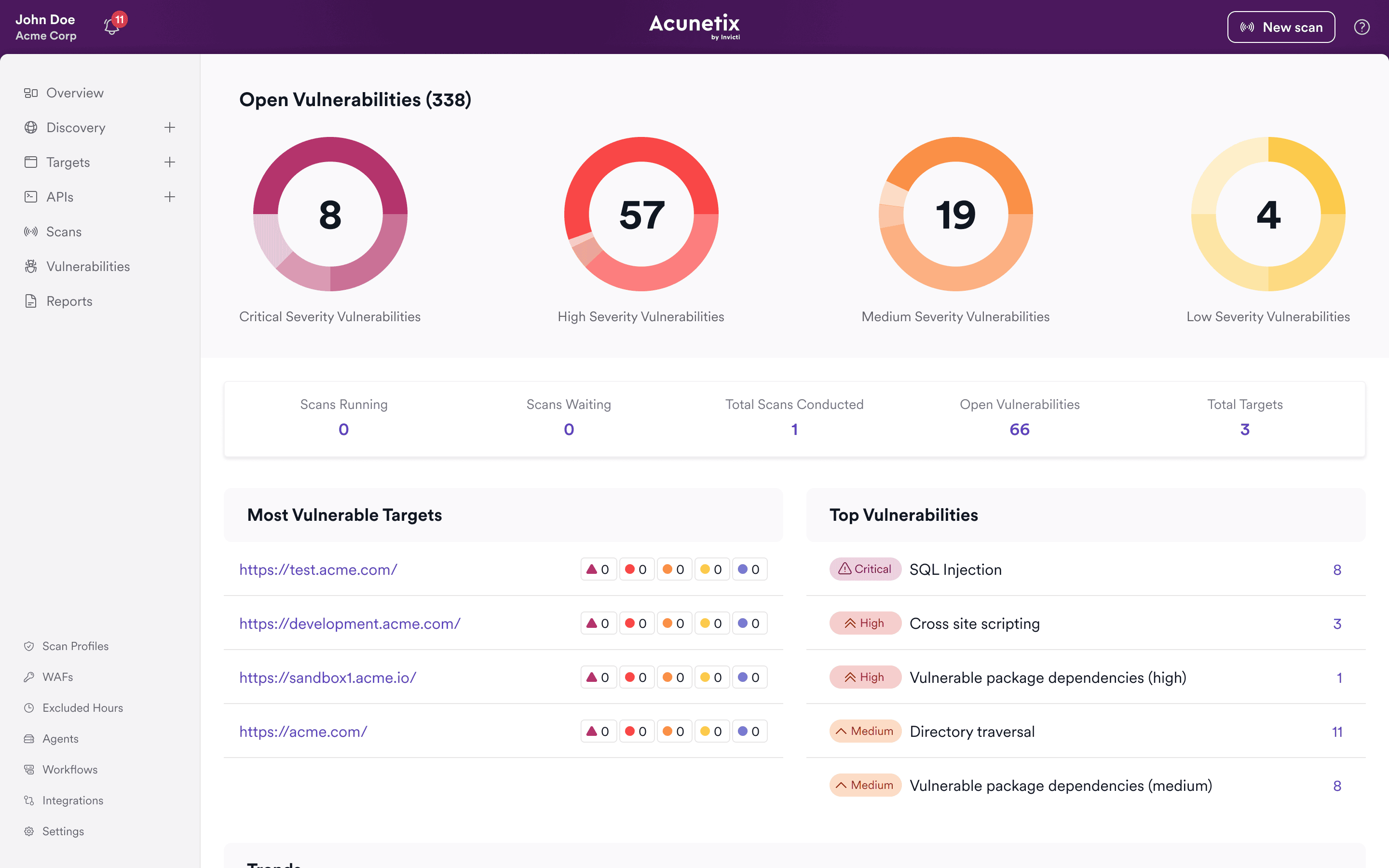
When Acunetix detects an SQL injection vulnerability, it provides detailed technical information to help you understand and remediate the issue:
- The affected URL or API endpoint
- The parameter used for injection
- The payload and request sent by the scanner
- The server response demonstrating the vulnerability
- Clear remediation guidance for developers
With proof-based validation, confirmed vulnerabilities include evidence that demonstrates how the issue can be exploited. This reduces false positives and helps teams prioritize fixes more effectively.
Acunetix supports compliance reporting aligned with standards such as OWASP Top 10 and PCI DSS. Findings can also be fed directly into to issue trackers and development workflows to make it easier to integrate security testing into your existing processes.
Request a demo to explore how Acunetix reports and validates SQL injection vulnerabilities in your own applications.
Frequently asked questions
A SQL injection online scanner is a SaaS-based security testing tool that analyzes a running web application to detect SQL injection vulnerabilities. It sends test inputs to the application and evaluates how the backend database responds to identify unsafe query handling.
Yes. With a SaaS-based scanner like Acunetix, you can test your web applications and APIs without installing on-premises software. You start by configuring a scan and providing a target URL, after which the scanner performs automated testing against your application.
A SQL injection test involves identifying input points, sending crafted SQL payloads, and analyzing application responses to determine whether injected queries are executed. This can be done manually or using automated scanning tools for broader coverage.
- In-band SQL injection returns data directly in the application response
- Blind SQL injection relies on indirect signals such as response differences or timing
- Out-of-band SQL injection uses external channels to confirm exploitation
Modern scanners like Acunetix test for all three techniques to ensure comprehensive detection.
When performed correctly, automated SQL injection scanning uses controlled and non-destructive payloads designed to test for vulnerabilities without harming the application or data. Acunetix is built to safely test production and staging environments.
Automated scanners can detect the majority of SQL injection vulnerabilities, especially when combined with authenticated scanning and proper configuration. For maximum coverage, automated testing is often complemented by targeted manual testing in high-risk areas.
Recommended Reading
Learn more about prominent vulnerabilities, keep up with recent product updates, and catch the latest news from Acunetix.




“We use Acunetix as part of our Security in the SDLC and to test code in DEV and SIT before being promoted to Production.”
Kurt Zanzi, Xerox CA-MMIS Information Securtiy Office, Xerox